
Welcome to The Great Houses Annual Champagne Review 2026!
Welcome to my annual The Great Houses Review, an in-depth exploration of the Champagnes made by the region’s houses and cooperative brands. My aim is to taste as comprehensively as possible, covering both the wines currently on the market and those about to be released. Its companion, The Great Growers Review, dedicated to Champagne’s independent growers, will follow in the spring.
This is a deeply personal review. It draws not only on the samples tasted for this edition but also on many years of knowing these producers, their philosophies and the wines they have made over time. For this report I tasted openly, using that experience to place each Champagne in context.
I hope this Review proves both an enjoyable read and a practical companion. Use it to discover new favourites, spot outstanding bottles, buy with greater confidence and build a cellar with lasting rewards. Whether you are looking for a bottle to open tonight or a treasure to lay down for years, I hope it helps you find the Champagne that speaks to you.
Essi Avellan MW
October 2026
How I Tasted
Wine is ultimately a matter of taste, and this Review reflects mine. I place great value on purity, brightness, finesse and textural charm, and I have little patience with faults such as premature oxidation or excessive volatile acidity. Technical soundness is my starting point as only once a wine is correct can I begin to appreciate its body and soul.
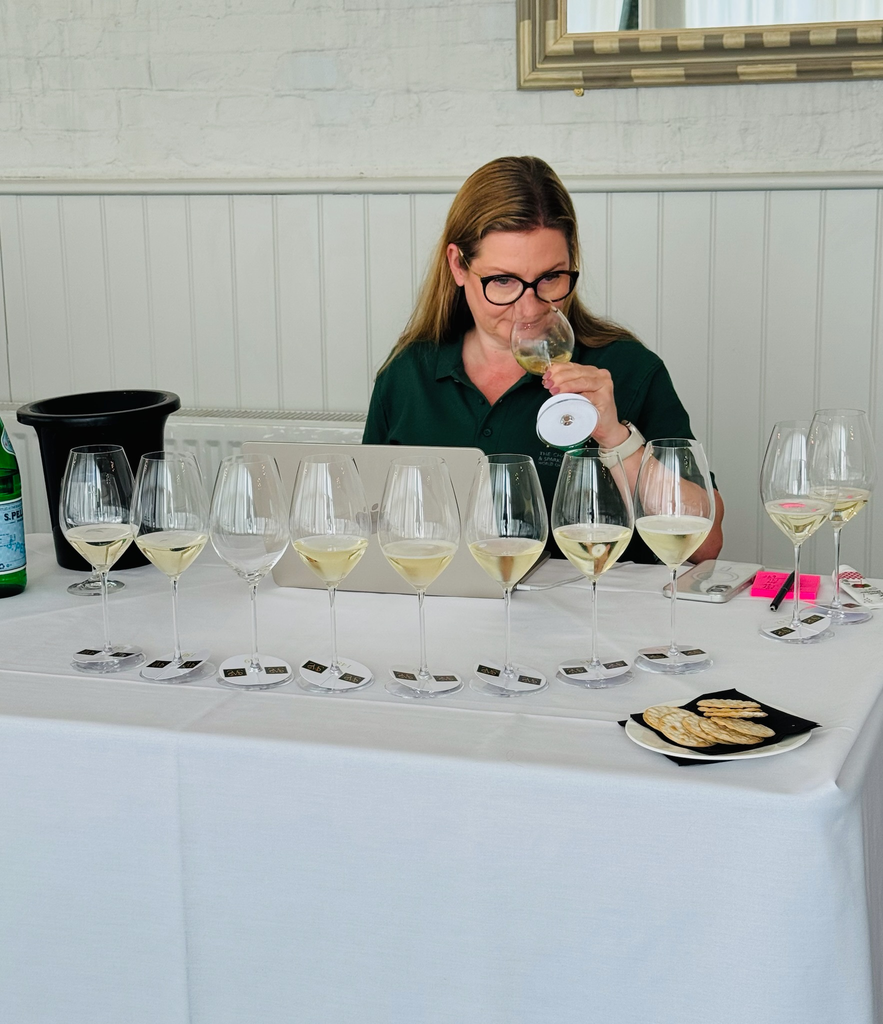
For this edition, I was delighted to work with the Union des Maisons de Champagne (UMC). The UMC kindly coordinated the collection of samples in response to my invitations to houses and cooperatives, and provided a dedicated space for my tastings. My sincere thanks go to the whole team for their warm welcome, their generosity and the considerable effort they put into hosting meand my team.
All wines were tasted openly, with each producer’s Champagnes assessed together. This gave me a complete view of each range and allowed a meaningful judgement of quality and consistency across the portfolio. I had visited some producers in the couple of months before the Review, and where I had tasted the relevant wines very recently, I drew on those notes rather than reassessing them.
Throughout, I used my trusted handmade Lehmann Grand Champagne glass, which has long been my all-round glass of choice for Champagne. I find that it works almost like a magnifying glass, revealing a wine’s aromatic detail better than any other while highlighting the champagne’s finesse and vivacity.
Where available, I have included technical details such as dosage and the closures used for both tirage and final bottling. These offer valuable insight into how a Champagne was made and how it is likely to evolve.
The Review features the 434 Champagnes that scored 87 points or more in my tastings. Not every Champagne is made with the same purpose or lifespan in mind. Some are designed for immediate pleasure, while others have the structure and substance to develop over decades. To reflect this, I give each wine two scores: one for its quality and expression today, and one for its future potential. I also suggest a drinking window, whose final year marks when I expect the wine to have reachedits full potential.
The perfect moment to open a bottle is, of course, also a matter of personal preference. Some drinkers love youthful energy, freshness and primary fruit; others look for the depth, savoury complexity and nuance that come with age. My drinking windows are a guide, not a prescription. Use them as a starting point and adapt them to your own palate and the styles you enjoy most.
Finally, bringing this report to life was a true team effort, and I would like to extend my heartfelt thanks to my team: Emma Liljeström for coordinating the tastings and managing the data, Jarno Laine for the IT expertise, Jouna Surenkin for the graphic design, and Michaël Boudot for the illustrations. Your skill and enthusiasm have been invaluable to this project.
Essi Avellan MW is an internationally renowned Champagne and sparkling wine specialist, author and passionate advocate for the world’s finest bubbles. In 2006, she became Finland’s first Master of Wine, earning both the Lily Bollinger Medal for best tasting performance and the Tim Derouet Memorial Award for best overall student.
A prolific author, Essi has written several wine books and revised and expanded the third and fourth editions of Tom Stevenson’s award-winning Christie’s World Encyclopedia of Champagne & Sparkling Wine. She contributes to leading wine publications, serves on The World of Fine Wine tasting panels and is a jury member of the Champagne & Sparkling Wine World Championships (CSWWC). Her annual Champagne Reviews and extensive library of tasting notes are available at essiavellan.com.
Essi’s deep commitment to Champagne has also earned recognition in France. She was named Chevalier de l’Ordre du Mérite Agricole by the French Minister of Agriculture and is a Dame-Chambellan of the Ordre des Coteaux de Champagne.
About the photography
My Champagne journey has been shared with Michaël Boudot ever since we began working together in 2009. As a born-and-raised Champenois, Mika took me behind the scenes and introduced me to many of the region’s people, helping me understand Champagne through local eyes. Back then he was an aspiring young photographer and visual creator. Today he is a recognised artist, a world-class professional and a dear friend. His photographs are full of emotion: they catch fleeting moments and convey the very essence of Champagne, its people and its wines. I am truly honoured to have his art illustrate this review.
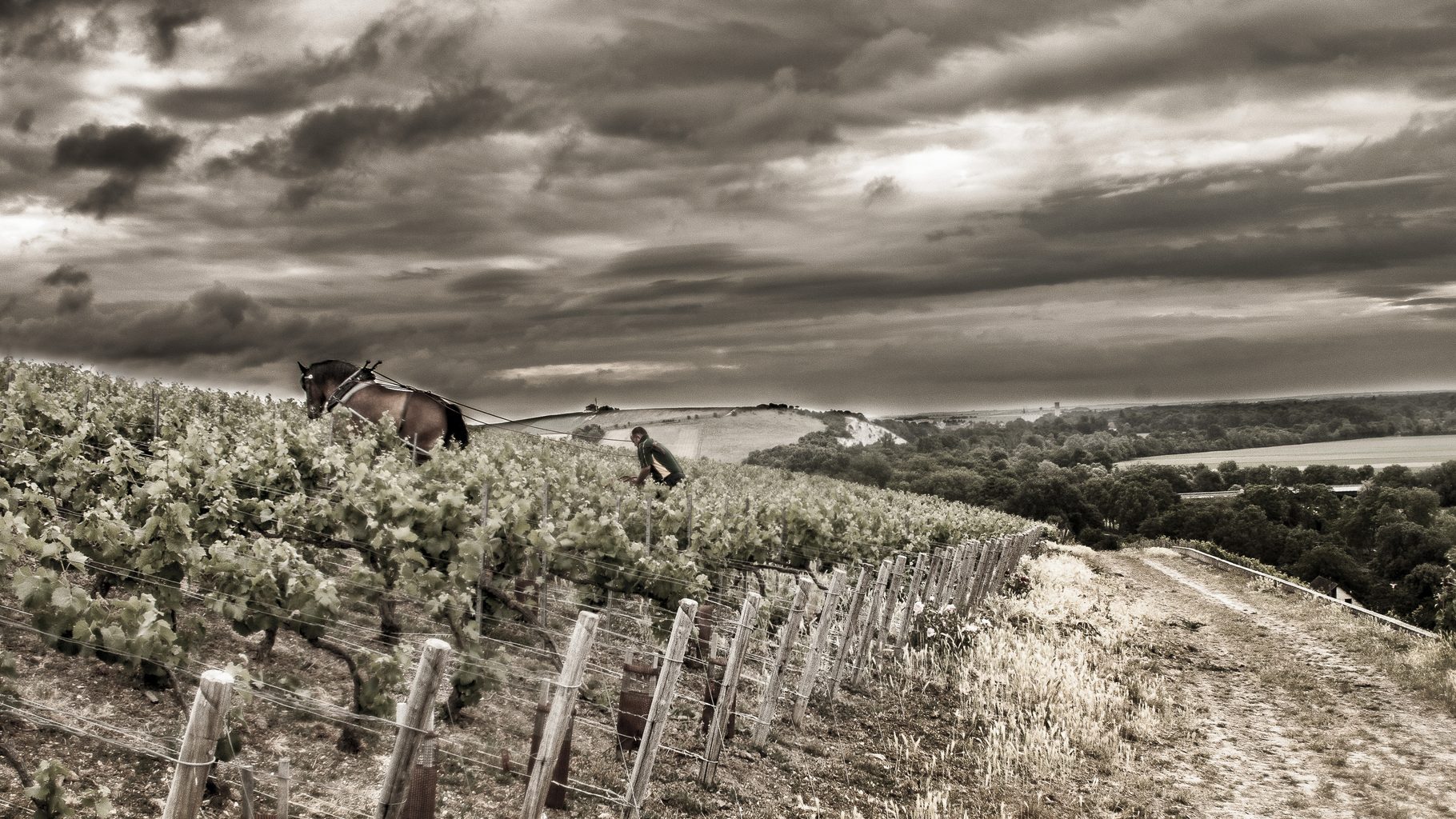
Michaël Boudot is a photographer and visual storyteller whose roots run deep in Champagne. For twenty years he has worked alongside the people who shape the world of wine. His journey began in the Montagne de Reims, and has since taken him through vineyards across Europe to capture the craft, the people and the spirit of each place. He works with curiosity, a love of light and deep respect for savoir-faire. For Michaël, every image preserves a moment and the story behind it.
The state of the Champagne market
Champagne spent the past years riding a wave, and then feeling it break. It all began with Covid, which triggered unprecedented buying patterns. Demand surged, stocks dwindled and prices climbed. For a while, it seemed entirely possible that the world might run short of Champagne, and prices reflected that sense of scarcity.
Yet beneath the apparent boom, a very different reality was taking shape. Alcohol consumption was beginning to decline, while political uncertainty, higher interest rates and mounting living costs squeezed disposable incomes. The mood shifted, and the market cooled almost as quickly as it had heated up.
The correction has been substantial. Global shipments fell to 266.1 million bottles in 2025, down 2.1% on 2024 and 10.6% below the pre-pandemic level of 2019. In today’s high-cost-of-capital environment, holding excess stock is expensive, while the high cost of grapes continues to put pressure on the houses. Champagne’s challenge is no longer simply how to satisfy demand, but how to bring production, inventories and pricing back into balance.
There are, however, some tentative signs of stabilisation in 2026. I discussed the situation with David Chatillon, president of the Union des Maisons de Champagne (UMC) and co-president of the Comité Champagne, as the industry faced another pivotal harvest. The houses and growers agreed on a marketable yield of 8,800 kg/ha, down from 9,000 kg/ha in 2025 and 10,000 kg/ha in 2024. As Chatillon explained, the decision was intended to rebalance stocks gradually without compromising the economic viability of the vineyards or Champagne’s quality standards. The adjustment marked the fourth consecutive annual reduction in the commercialisable yield.
The lower limit was not universally welcomed by growers, whose livelihoods depend on the volume of grapes they can sell. Yet nature had its own say, and the actual agricultural yield in manyareas fell well below the permitted limit. Early estimates pointed to an average of around 7,000 kg/ha, underlining the difference between the yield the industry authorises for commercialisationand the crop the vineyards ultimately deliver.
Pricing is another piece of the puzzle. Certain major players announced grape-price reductions early in the season, potentially setting a precedent for others. How far those reductions will go, and how quickly they will feed through into Champagne prices, remains to be seen. For the houses, the challenge is to restore competitiveness and manage inventories without eroding the value of their brands.
The financial pressures are also becoming visible at company level. Maison Pommery & Associés, owner of the Pommery, Maison Pompadour, Vranken and Charles Lafitte Champagne brands, attracted considerable attention in 2026 amid discussions with Henkell Freixenet about a potential strategic partnership. Those talks ended without an agreement in August, but the company subsequently secured financing to cover its needs until June 2027, with a possible extension into 2028 subject to conditions. The episode illustrates the pressures facing even established names as the Champagne market adjusts to a new reality.
Whether 2026 marks the beginning of a recovery remains uncertain. There are some encouraging signs: Champagne shipments have risen modestly in the first nine months of the year summing to 174,2 million bottles (+3,2% compared to 2025).
In general, Champagne sales have picked up across several of the region’s key export markets, from Europe to the United States, Japan and Australia. New trade opportunities may provide further impetus. The EU–Mercosur agreement, provisionally in force since May 2026, has already eliminated tariffs on certain high-value sparkling wines, opening up new opportunities in South America. India could also become a more attractive growth market from 2027 onwards, provided the EU–India trade agreement enters into force on the anticipated timetable.
According to Chatillon, the export-oriented houses are better positioned to benefit from this international momentum. “The houses lead exports, so we are seeing a more positive trend for them. Consumption in France continues its decline,” he explains. The figures illustrate just how profoundly Champagne’s domestic market has changed. Thirty years ago, France accounted for 63% of Champagne sales; today, its share has fallen to just 43%. This long-term decline reflects a combination of changing consumption habits and mounting economic pressures on French households.
“Champagne is a barometer of people’s mood, and in France the mood is not great. We have geopolitical tensions and political instability, purchasing power is under pressure, and alcohol consumption is declining,” Chatillon explains.
This shift has created more room for competing sparkling wines, particularly Crémant and Prosecco. Champagne is responding collectively, seeking to broaden its appeal beyond traditional celebrations and encourage consumers to discover new occasions for drinking Champagne.
One expression of this renewed promotional effort was the inaugural Champagne Week in Paris, held from 19 to 25 October 2026. Organised collectively by Champagne’s growers and houses through the Comité Champagne, the initiative brought together restaurants, bars and wine merchants to showcase Champagne through tastings, food pairings and other experiences designed to reach consumers in new ways.
The next major initiative will bring the spotlight back to the region itself. Champagne Rendez-Vous, scheduled for 5 June 2027 in Reims, is intended to unite the Champagne community and draw attention to the region’s wines, people and expertise. Together, these initiatives signal a collective effort to strengthen Champagne’s connection with consumers and cultivate new drinking occasions.
Champagne is not in crisis, but in correction, and every correction brings opportunity as well as pain. Recovery will not be swift, and the pressure on growers and houses will not ease overnight. For drinkers, however, the outlook is unusually bright: greater choice, more competitive pricing, wines that have spent a little longer in the cellar, and a pipeline of fine vintages still to come.
The review: a remarkably strong showing
Tasting almost 450 Champagnes was no small undertaking, but it was an immensely rewarding one. Above all, it offered a compelling snapshot of the quality currently available on the market. I could not resist putting the results under the statistical microscope, either. Faulty bottles were remarkably few, and very few wines failed to reach the 87-point threshold. The overall standard was impressively high, reflected in an average score of 91.8 points and no fewer than 59 wines achieving 95 points or more.
At the very top, Dom Pérignon P2 2008 led the field with 99 points. Seven wines occupied the next tier at 98: Dom Pérignon P2 Rosé 1996, Dom Ruinart 2013, Dom Ruinart Rosé 2013, Henriot L’Inattendue 2016 (magnum), Pol Roger Sir Winston Churchill Vinothèque 2004 (magnum) and Palmer Collection Blanc de Blancs 1995 (magnum).
Perhaps the most intriguing finding was the strength of rosé Champagne. Prestige and vintage rosés averaged 93.4 points, outperforming every other style-and-category combination. The category was particularly rich in outstanding wines, with Dom Pérignon P2 Rosé 1996 and 2002, Dom Ruinart Rosé 2013 and 2009, and Perrier-Jouët Alexandra Rosé 2012 among the standouts. Rosé is sometimes treated as a secondary consideration in the prestige Champagne hierarchy, but my palate has long argued otherwise.
At the other end of the stylistic spectrum, Blanc de Noirs was the weakest performer, both among non-vintage wines (90.6) and vintage Champagnes (90.8). No Blanc de Noirs reached 95 points, although Bruno Paillard Blanc de Noirs, Bollinger PN AyC 21, Philipponnat Blanc de Noirs 2021 and Piper-Heidsieck Essentiel Blanc de Noirs delivered particularly commendable performances. Blanc de Blancs, meanwhile, excelled in the non-vintage category, averaging 91.3 points making it the strongest NV style. My highest points went to Piper-Heidsieck Essentiel Blanc de Blancs (magnum), Lallier Blanc de Blancs (magnum) and Charles Heidsieck Blanc de Blancs.
Dosage offered another revealing perspective. Extra Brut Champagnes averaged 92.2 points, ahead of Brut at 91.7 (though some of these carry a dosage low enough to qualify as Extra Brut) and Brut Nature at 91.4. Bone-dry Champagne is notoriously difficult to master, and the figures suggest that it leaves less room for error. Yet the finest examples showed how brilliantly zero dosage can succeed when a wine has the substance, maturity and balance to carry it. Moët & Chandon Collection Impérial Création No. 1 (96), Laurent-Perrier Blanc de Blancs Brut Nature and Palmer La Réserve Nature (both 93) made a persuasive case.
The houses and the vintages
The house rankings were headed by Dom Pérignon, with an impressive average of 96.8 points, followed by Rare Champagne (95.3), Charles Heidsieck (94.7), Bollinger and Louis Roederer (94.3), Pol Roger (94.2) and Perrier-Jouët (94.0). These averages reflect the strength of the wines submitted across each portfolio, rather than the performance of a single exceptional cuvée.
Among vintage Champagnes, 2012 and 2013 shared the highest average at 93.5 points. The former was represented by such excellent wines as Rare Champagne, Bruno Paillard NPU, Laurent-Perrier Alexandra Rosé, Henriot Vintage and Les Clos Pompadour. The 2013s delivered an equally impressive showing, led by the Dom Ruinart pair and Taittinger Comtes de Champagne Rosé. The 2018 vintage came remarkably close, averaging 93.2 across a much larger group of 41 wines. Its breadth was particularly encouraging, with Louis Roederer Cristal, Pol Roger Sir Winston Churchill, Bollinger La Grande Année and Dom Pérignon among the highlights.
Not every recent vintage was quite so convincing. The 2015s proved distinctly uneven, averaging 92.1 points across a wide range of 89 to 96. A recurring vegetal austerity detracted from the appeal of many wines, making Palmer & Co Grands Terroirs in magnum all the more delightful an exception. The 2020s fared worse still, averaging just 90.8, with vegetal and phenolic characters too often compromising their balance and charm. For non-vintage Champagnes, the 2019 and 2021 base years performed best, averaging 91.4 and 91.2 points respectively. This probably reflects the exceptional quality of 2019, as well as my personal preference for the tension and freshness that 2021 provided, even if it was not a great vintage across the board.
The magnum advantage
One of the clearest patterns to emerge concerned bottle format, although this should hardly come as a surprise to anyone familiar with Champagne’s ageing dynamics. Magnums averaged 93.3 points, compared with 91.6 for standard bottles. The advantage held across all three categories: 91.9 versus 90.8 for non-vintage, 94.2 versus 92.8 for prestige cuvées, and 94.7 versus 92.0 for vintage Champagnes.
The difference was equally striking at the top end: 34% of magnums achieved 95 points or more, against just 11% of standard bottles. In five direct comparisons of the same wines in both formats, the magnum came out ahead every time, by one to three points.
Of course, this is not a controlled scientific experiment, but the consistency of the results is striking.Magnum is, quite simply, one of Champagne’s most rewarding formats for ageing.
The category-based top lists will provide a more detailed guide to the strongest performers. But the overarching conclusion is clear: despite the challenges facing the Champagne market, its wines have rarely given more reason for optimism. The depth of quality is impressive, the leading houses continue to deliver exceptional wines, and some of the most exciting performances came from categories that deserve greater attention.
Join the bubbles!
This content is exclusive to Annual Champagne Review buyers and of course our full members!
Become a member or purchase the review to unlock it!